Aren't you excited by the crazy amount of features and benefits that this phone has to provide for all us consumers and techno-gadget fanatics?
Didn't you feel that perhaps it was time we went about discovering one of the most powerful and brilliant inventions of our 21st century in this very very special universal touchscreen gadget embedded with the endless features of Wi-Fi, Mp3, Camera, Internet, Email, Multimedia?
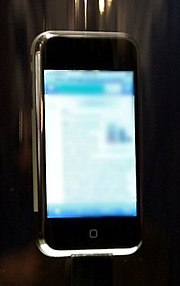
With due courtesy of Wikipedia
The iPhone is a multimedia and Internet-enabled mobile phone by Apple, announced by Apple CEO Steve Jobs during the keynote address at the Macworld Conference & Expo on 9 January 2007, that is scheduled to be released on 29 June 2007[1][2][3] in the U.S. at 6 p.m "local time."[4] [5] [6]
The iPhone's functions include those of a camera phone, a multimedia player, mobile phone, and Internet services like e-mail, text messaging, web browsing, Visual Voicemail and wireless connectivity. iPhone input is accomplished via touchscreen with virtual keyboard and buttons. The iPhone is a quad-band GSM phone, though Jobs mentioned in his keynote that Apple has a "plan to make 3G phones" in the future.[7] Apple has filed more than 200 patents related to the technology behind the iPhone.[8]
....
The 3.5 inch (8.9 cm) liquid crystal display (320×480 px at 160 ppi) HVGA touch screen topped with optical-quality glass[29] is specifically created for use with a finger, or multiple fingers for multi-touch sensing. No stylus is needed, nor can one be used, as the touch screen requires bare skin to operate.[30]
For text input, the device implements a virtual keyboard on the touchscreen. It has automatic spell checking, predictive word capabilities, and a dynamic dictionary that learns new words. Notably, the predictive word capabilities have been integrated with the dynamic virtual keyboard so that users will not have to be extremely accurate when typing — i.e. touching the edges of the desired letter or nearby letters on the keyboard will be predictively corrected when possible. Additionally, an optional landscape mode for text entry with the virtual keyboard has been mentioned by Apple executives as a possibility for iPhone, but Apple has not yet come to a final decision as to its inclusion in the shipping version of iPhone. A possible advantage of landscape text entry would be the availability of larger keys to ease text entry, especially for individuals with larger fingers.
The iPhone varies from common desktop interfaces by using a direct manipulation model of scrolling. Where a typical desktop GUI achieves scrolling by using a scroll-arrow to push a view-window down and thus the content itself up (or the reverse, clicking up to move content down), the iPhone interface enables the user to move the content itself up or down by a touch-drag-lift motion of the finger, much as one would slide a playing card across a table. Additionally, the speed desired for scrolling is computed based on the speed and acceleration with which the drag motion is performed.
Scrolling through a long list works as if the list is pasted on the surface of a wheel: the wheel can be "spun" by sliding a finger over the display. After the finger is lifted from the display the wheel continues to "spin" for a short moment before coasting down. In this way, the iPhone seems to simulate the physics of a real object, which, it is thought, should give a natural feel to the whole process.
The UI also features other visual effects, such as horizontally sliding sub-selections and co-selections from right and left, vertically sliding system menus from the bottom (e.g. favorites, keyboard), and menus and widgets that turn around to allow settings to be configured on their back sides.
The photo album and web page magnifications are examples of multi-touch sensing. It is possible to zoom in and out of objects such as web pages and photos by respectively "unpinching" and "pinching" them, that is, placing two fingers (usually thumb and forefinger) on the screen and moving them farther apart or closer together as if stretching or squeezing the image. This scaling is done uniformly and proportionally based on the image in question so there is no distortion of the image itself, as would be the case if the image were actually stretched or squeezed.
Other inputs
The display responds to three sensors: a proximity sensor that shuts off the display and touchscreen when the iPhone is brought near the face to save battery power and to prevent spurious inputs from the user's face and ears, an ambient light sensor that adjusts the display brightness which in turn saves battery power, and an accelerometer, which senses the orientation of the phone and changes the screen accordingly, albeit in only one 90 degree direction.
A single frontal hardware button brings up the main menu. Subselections are made via the touchscreen. The iPhone utilizes a full-paged display, with context-specific submenus at the top and/or bottom of each page, sometimes depending on screen orientation. Detail pages display the equivalent of a "Back" button to go up one menu.
The iPhone has three physical switches on its sides: sleep/wake, volume up/down, ringer on/off. All other multimedia and phone operations are done via the touch screen.
Phone
The iPhone allows conferencing, call holding, call merging, caller ID, and integration with other cellular network features and iPhone functions. For example, a playing song fades out when the user receives a call. Once the call is ended the music fades back in.
The iPhone will include a Visual Voicemail feature in conjunction with AT&T Mobility, formerly Cingular Wireless, which allows users to view a list of current voicemail messages onscreen, without having to call into their voicemail. Unlike most other systems, messages can be listened to in a non-chronological order, by choosing messages from an on-screen list. AT&T completely reworked their voicemail infrastructure to accommodate this new feature designed by Apple.
SMS messages are presented chronologically in a mailbox format similar to Mail, which places all text from recipients together with replies. Text messages are displayed in speech bubbles (similar to iChat) under each recipient's name.
Camera
The iPhone features a built in 2.0 megapixel camera located on the back, the camera cannot record video at this time. It also includes software that allows the user to upload, view, and e-mail photos. The user zooms in and out of photos by "unpinching" and "pinching" them through the Multi-touch interface. The software will interact with iPhoto on the Mac.
Multimedia
The layout of the music library differs from previous iPods, with the sections divided more clearly alphabetically, and with a larger font. The Cover Flow, like that on iTunes, shows the different album covers in a scroll-through photo library. Scrolling is achieved by swiping a finger across the screen.
Like the fifth generation iPods introduced in 2005, the iPhone can play video, allowing users to watch TV shows and films. Unlike other image-related content, video on the iPhone plays only in the landscape orientation, when the phone is turned sideways. A two-fingered tap is used to switch between the video's true wide-screen aspect ratio (with black bars on the top and bottom of the screen) and a zoomed mode (to fill the iPhone's screen).
Internet
The iPhone has built-in WiFi, with which it will be able to access the Internet (through a wireless network) via a modified version of the Safari web browser. The iPhone will also be able to connect to the Internet through AT&T's EDGE network but will not be able to utilize AT&T's 3G/HSDPA network at launch, however Steve Jobs' mentioned at the Keynote presentation that 3G support would be a future feature.[30] The web browser displays full web pages as opposed to simplified pages as on most other phones. However, as of WWDC 2007, the iPhone does not support Flash technology.[31] Web pages may be viewed in portrait or landscape mode and support automatic zooming by "pinching" or double-tapping images or text. The iPhone also has Bluetooth 2.x+EDR built in. It works with wireless earpieces that use Bluetooth 2.0 technology and allows file transfer.
An agreement between Apple and Google provides for access to a specially modified version of Google Maps — in map, local list, or satellite form, optimized for the iPhone. During the launch of the product, Jobs demonstrated this feature by searching for nearby Starbucks and then placing a prank call to one with a single tap.[32]
The iPhone also features an HTML e-mail program, which enables the user to embed photos in an e-mail message. Yahoo! will be providing a free Push-IMAP e-mail service similar to that on a BlackBerry; IMAP and POP3 mail standards are also supported, including Microsoft Exchange. The iPhone will sync with e-mail programs such as Outlook, entourage and web based email accounts such as Gmail, .Mac mail and AOL. [33] There is no enterprise email connectivity[34] other than IMAP and POP3.
...............
for more information, read up here

No comments:
Post a Comment